
The Ultimate Guide to Standard Kitchen Counter Height
Your kitchen counter is the workhorse of your home. But if it is even an inch off, your morning coffee prep can turn into a literal pain in the neck.
Most homeowners accept the default height without realizing it was set decades ago. Back then, the average person was much shorter.
If you are planning a kitchen remodel, you need to know which numbers actually work. In this guide, you will learn the magic industry standard for countertop height.
We will also look at how to customize your space for your own body and how to handle kitchen islands. By the end, you will know exactly how to set up a kitchen that saves your back and looks great.
The Gold Standard: What is the Industry Norm?
The industry standard for kitchen counter height is 36 inches (91.4 cm). This measurement is taken from the floor all the way to the top of the countertop surface.
Think of this as a 36 inch sandwich. Here is how it breaks down:
- Base cabinets: These are usually 34.5 inches tall.
- Countertop thickness: A standard slab of granite or quartz is about 1.5 inches thick.
- Total height: Together, they reach that 36 inch mark.
And here is why that matters. Modern appliances like dishwashers and slide in ranges are built for this exact clearance. If you go lower, your dishwasher might not fit under the counter.
If you go much higher, your stove might sit in a hole. Sticking to 36 inches ensures your kitchen works with almost every appliance on the market today.
Ergonomics: Why “Standard” Might Not Fit You
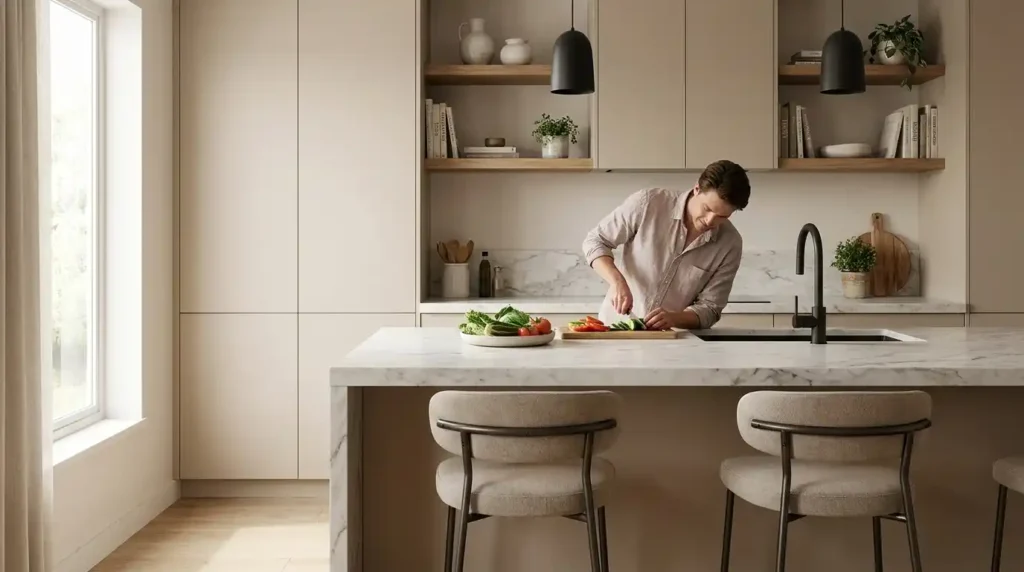
Does your back hurt after twenty minutes of chopping vegetables? If so, your counters might be the wrong height for your body.
Recent studies show that a 36 inch worktop is actually too low for most men and about half of all women. This causes you to slouch, which puts a heavy load on your spine.
You can find your perfect fit using the Elbow Rule. Stand up straight and bend your arm at a 90 degree angle. Your ideal prep height should be 3 to 4 inches below your elbow.
Specific tasks also need different heights:
- Chopping and Prep: These are best at the standard 36 inches or slightly higher.
- Kneading Dough: Heavy tasks like rolling dough feel better on lower counters, around 30 to 32 inches.
- Tall Users: If you are over 6 feet tall, you might want to raise your cabinets to 38 inches to avoid leaning over.
Kitchen Island vs. Perimeter Heights
Kitchen islands often serve two purposes. They are for cooking and for hanging out. Because of this, they sometimes have two different heights.
If you have a single tier island, it usually matches the 36 inch perimeter. This keeps the room looking clean and open.
But many people prefer a two tier island, also called a breakfast bar. In this setup, the prep side stays at 36 inches. The eating side is raised to 42 inches.
You also need to think about walking space. You should leave 42 to 48 inches of aisle space between your island and your wall counters. This ensures that two people can pass each other without bumping elbows.
ADA and Accessible Design Rules

A good kitchen works for everyone. If you are building for accessibility, the ADA standard says counters should be no higher than 34 inches. This makes them reachable for someone in a wheelchair.
To make a counter truly accessible, you also need knee clearance. This means leaving an open space under the counter that is at least 27 inches high and 30 inches wide. Many modern homes now use universal design.
This means mixing different heights, like a 30 inch table area and a 36 inch prep area, in the same kitchen. This setup works for kids, adults, and seniors all at once.
Making It Happen
While 36 inches is the king of standard kitchen counter height, the best kitchen for 2026 is one that fits your life.
A kitchen should help you cook without pain. It should also keep your home’s resale value high by staying close to recognized standards.
Check your current counter height today. Stand at your sink and see if you have to hunch over. If you do, it might be time to think about a custom adjustment for your next remodel.
Start by measuring your elbow height and see how far off your current counters really are.